

A sequence of trade research launched in 2026 paints an image of fixing observe and practitioners. From gender fairness to sustainability, price escalation to wellbeing, the numbers inform us about an structure trade in flux. Learn an evaluation of the sustainability knowledge from the 2026 Australian Institute of Architects’ 2026 nationwide awards program under.
Since 2023, the Australian Institute of Architects has included six sustainability standards for entries to all its award applications at state and nationwide ranges. To be eligible for an award, undertaking entries should meet no less than two of the six standards, which embody concerns resembling using onsite sources, ecological regeneration and minimising of air pollution.
In 2026, a complete of 669 initiatives had been entered into the Australian Institute of Architects nationwide awards program. The entry knowledge, whereas self-reported, can present a captivating annual snapshot of how the career is progressing within the shift in the direction of sustainable observe. (This knowledge excludes responses the place the related criterion had been marked “not relevant” to the undertaking.)
Key takeaways
1. Sustainability confidence is excessive
Architects report robust efficiency throughout all six sustainability standards, resembling use of onsite sources throughout building (75.6 p.c), ecological restoration (73.7 p.c), and minimisation of building waste (83.4 p.c).
2. Robust consideration for passive design and local weather resilience
Passive design, local weather adaptation and local weather resilience emerge as areas of specific power within the reporting initiatives – 93.6 p.c used passive design rules, and 89.9 p.c confirmed consideration for local weather adaptation and resilience.
3. Sustainability efforts are frequent, although motion plans lag
Sustainability measures at the moment are widespread, with 92.5 p.c of entrants reporting that measures are in place of their observe (Graph 4.1). Nevertheless, a smaller quantity (67.6 p.c) stated they’d adopted a proper Sustainability Motion Plan (Graph 4.2).
4. The entire-life carbon hole
Whereas 60.8 p.c of initiatives report using a sustainability certification system, together with a spread of nationwide and worldwide requirements (Graph 4.3), using Entire Life Carbon and Life Cycle Assessments stays far much less frequent at 20.9 p.c (Graph 4.4).
5. Embodied carbon and the web zero problem
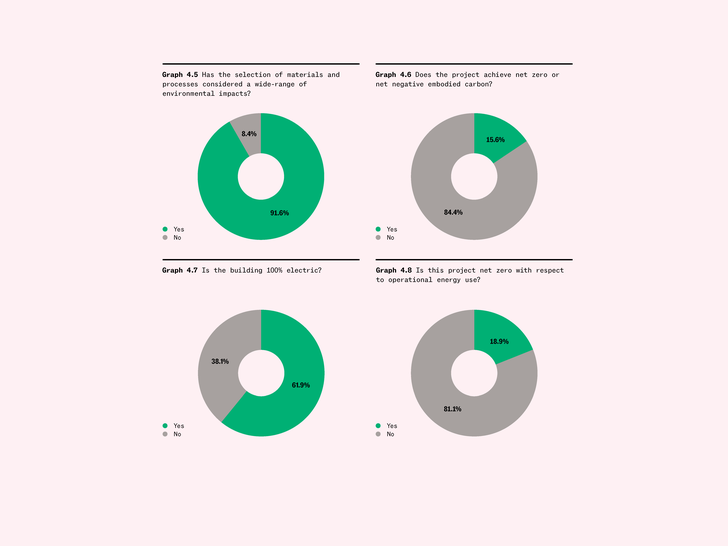
Most entrants (91.6 p.c) report a variety of environmental impacts had been thought-about throughout materials picks (Graph 4.5). Initiatives managing to achieve web zero embodied carbon, nevertheless, stay uncommon at 15.6 p.c (Graph 4.6).
6. Renewables lead operational power discount
Whereas solely 61.9 p.c of initiatives are absolutely electrical (Graph 4.7), renewable power is the popular strategy to lowering operational carbon (76.2 p.c). Internet zero operational power outcomes stay restricted at 18.9 p.c (Graph 4.8).
View gallery
Evaluation by Liz Brogden, College of Queensland, on behalf of the Australian Institute of Architects.
This text is the third in an Structure Australia (Nov 2026) “trade in overview” sequence that unpacks findings of a number of trade research launched in 2026. Learn an evaluation of the outcomes of the Affiliation of Consulting Architects’ 2026 Pulse Verify survey right here; the Commonwealth Affiliation of Architects’ 2025 Survey of Structure College students, Graduates and Early Profession Professionals right here; and the Office Gender Equality Company’s 2026 knowledge right here.