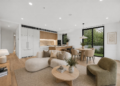


Native studio Estudio A-G has foregrounded a sculptural timber structural ingredient whereas implementing daring colors for the renovation of a Sixties home in Mexico Metropolis.
Initially in-built 1962 by Jaime Ortiz Monasterio, Casa Magnolia is positioned within the residential neighbourhood of San Ángel.
Monasterio designed the house as a home library for his brother, who was an avid reader and e-book collector. Over the many years, the home was renovated a number of instances, obscuring the house’s unique character.
In 2025, Andrés Gutiérrez, head of Estudio A-G, was commissioned to reinterpret the inside of the 275-square-metre residence for brand spanking new inhabitants, preserving the architectural qualities that made the unique design distinctive.
“The restoration was extraordinarily respectful of the home’s unique structure, however we by no means needed the consequence to really feel nostalgic,” Gutiérrez advised Dezeen.
“Fairly the other – as soon as restored, the home wanted to really feel fully new, contemporary and modern, which was precisely what the purchasers had been searching for.”
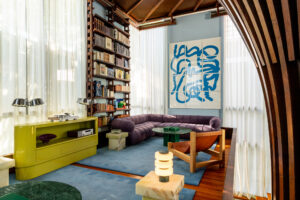
Accomplished in February 2026, the design makes use of color to attain the transformation, bringing new vitality to the unique structure with out competing with it. The studio aimed to have the home be recognisably Mexican with out falling into tropes.
“I needed the home to really feel unmistakably Mexican, however with out counting on folklore or the same old clichés related to ‘Mexican interiors’.” he mentioned.
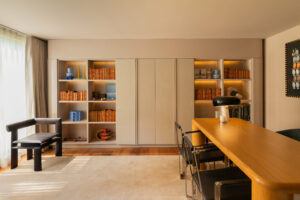
“I used to be far more desirous about expressing that identification by means of supplies, craftsmanship, color and modern Mexican design.”
On the centre of the home, a dark-toned timber construction rises by means of a sequence of cut up ranges like a sculptural tree connecting the doorway corridor, lounge, eating room, research and studying areas earlier than unfolding right into a double-height ceiling.
“Greater than a structural ingredient, it serves as a spatial anchor, establishing continuity all through the inside and reinforcing the vertical dimension of the home,” Gutiérrez mentioned, explaining that wooden acts as a heat, unifying ingredient all through the home.
The studio restored and reintegrated the unique wooden flooring, ceiling finishes and structural components. It additionally reinstalled a lot of the unique wood bookshelves that had been dismantled and saved.
“General, the intervention targeted on restoring the weather that had been value preserving whereas introducing the required modern updates to make the home totally practical for the best way its new homeowners reside right now,” he mentioned.
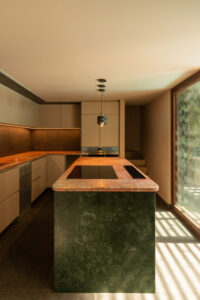
The studio changed some window frames and all of the glass, up to date the lighting and electrical techniques and rebuilt the loos and kitchen.
Nevertheless, one of the crucial vital interventions had been the color blocks and new supplies included within the area.
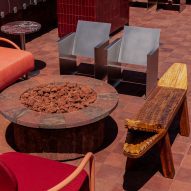
“Color performs a central position within the mission,” Gutiérrez mentioned, calling out delicate blue partitions which can be a backdrop for deep plum sofas, moss inexperienced eating chairs, lilac rugs, inexperienced serpentine stone and terracotta-toned marble.
“Quite than performing as ornament, color is used as an architectural software to organise area, set up hierarchy, and form ambiance.”
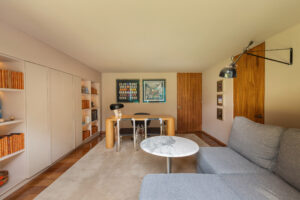
He additionally designed customized furnishings that pairs with historic items – like Antonio Attolini’s 1969 armchairs – and modern Mexican artwork. Works by Cecilia Barreto, Francisco Muñoz, Jorge Rosano, Daniel Berman and Adriana Silva embed tradition into on a regular basis life.
Beforehand, Estudio A-G designed a rooftop bar as a “matriarchal universe,” full with crocodile-shaped furnishings and shrine-like water, for a boutique lodge in a former Spanish colonial manor home in San Miguel de Allende.
Challenge credit:
Inside design: Estudio A-GFeatured furnishings & design manufacturers: Estudio A-G, Los Patrones, Herman Miller, Adhoc, Bibi Bibi, Comité de Proyectos, Alan SaenzFeatured artists: Cecilia Barreto, Francisco Muñoz, Jorge Rosano, Daniel Berman, Adriana Silva
Share
Pictures by Leandro Bulzzano, Ricardo Letona