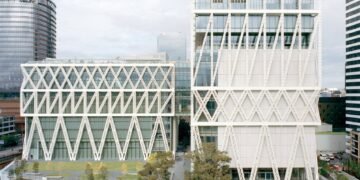


Every of us wants of a roof over our head, lecture rooms to study in and places of work or house to work from.
To satisfy this unprecedented demand for brand new buildings, globally we’re developing the equal of a whole New York Metropolis each month.
This offers us with very important infrastructure, but additionally generates an unlimited quantity of world-warming emissions.
So how can we construct what we want, with out harming our planet? Our new analysis offers some solutions.
The necessity to construct
Creating new buildings advantages communities, cities and nations, and eases housing stress. That’s why Australia’s Nationwide Housing Accord is aiming to assemble 1.2 million new, well-located properties between 2024 and 2029.
However this Australian effort is dwarfed by the 96,000 new and reasonably priced properties wanted worldwide each single day. Tragically, lots of of thousands and thousands of individuals all over the world endure homelessness. One in 4 reside in dangerous situations.
Nevertheless, development comes with a local weather value. Every time we construct, we use supplies and development processes that launch massive quantities of greenhouse gasoline emissions – referred to as “embodied carbon”.
To grasp the size of embodied carbon, image a sq. metre of flooring house. Setting up that sq. metre would launch round half a tonne of greenhouse gasoline emissions. Now scale that as much as constructing an entire New York-sized metropolis each month!
What we studied
Our new research examined tendencies in workplace constructing development in Australia. We at the moment have about 170 million sq. metres of workplace house throughout the nation, and are set to construct an extra 100 million sq. metres by 2049.
To research what impact these buildings have on world warming, we modelled their greenhouse gasoline emissions. We measured each their embodied carbon and working carbon – the emissions from on a regular basis heating, lighting, cooling and home equipment.
We discovered Australian workplace buildings are projected to launch 138 million tonnes of greenhouse gasoline emissions between 2024 and 2049. This quantity is equal to the annual emissions of 36 coal-fired energy stations. Given places of work make up simply 20 p.c of all business buildings in Australia, that is solely a fraction of our whole city emissions.
A combined image
Most surprisingly, working emissions represented 85 p.c of the entire in 2024, however are set to drop to simply 15 p.c by 2049. It’s because Australia is decarbonising our power sector by shifting from fossil fuels to photo voltaic, wind and different renewables.
Nevertheless, if we preserve constructing at our present pace and scale, our annual embodied emissions will stay at comparable ranges. In comparison with working emissions, it’s tougher to decrease embodied carbon as a result of many materials provide chains depend on fossil fuels and carbon-intensive practices. The method of producing cement, for instance, is liable for 8 p.c of all world carbon dioxide emissions.
We additionally in contrast workplace constructing emissions in Australia with emission pathways that might restrict the sector’s contribution to world warming under 1.5°C or 2.0°C. Nevertheless, we discovered cumulative emissions from places of work are over 40 p.c above these pathways. This implies workplace buildings will seemingly blow their carbon budgets inside a matter of years. We discovered Tasmania – which runs nearly fully on renewable power and has fewer workplace buildings per capita – is the one state or territory with annual emissions that sit constantly under the 1.5°C pathway.
Reducing carbon
Our research measured a number of methods to scale back embodied carbon in workplace buildings.
We discovered combining these methods might cut back whole emissions by over 47 million tonnes, placing the workplace sector far nearer to the two.0°C emissions pathway goal.
These outcomes present the significance of “sufficiency” measures, comparable to refurbishing present buildings and developing smaller, or fewer, new buildings.
Analysis exhibits sufficiency methods work. Take into account Sydney’s Quay Quarter Tower. This tower was initially in-built 1976 however, by the late 2010s, was older and fewer helpful. Moderately than demolish it, architects 3XN and BVN prolonged the tower to the north and upcycled two-thirds of the unique construction. This elevated workplace house whereas saving round 8,000 tonnes of embodied carbon.
Extra work forward
Our research suggests embodied carbon will, within the subsequent decade, overtake working carbon because the main supply of constructing emissions. That is problematic as a result of most nations don’t impose limits on embodied carbon. As a primary step, Australia should regulate embodied carbon emissions as different nations – together with Denmark, Finland, France, the Netherlands and Sweden – have already finished.
We also needs to provide incentives for the development sector to refurbish older buildings. A number of councils in the UK have adopted “retrofit first” insurance policies, the place builders should not less than think about choices for refurbishing buildings earlier than merely demolishing or changing them.
Our ever-growing world inhabitants calls for thousands and thousands of latest properties, workplaces and neighborhood areas. However to actually deal with local weather change, we should discover higher methods to steadiness society’s want for brand new house with a dedication to curb emissions.
This text is republished from The Dialog underneath a Inventive Commons license. Learn the unique article by Philip Oldfield, head of faculty and professor of structure, UNSW Constructed Surroundings, UNSW and William Craft, senior analysis affiliate, Faculty of Constructed Surroundings, UNSW.